

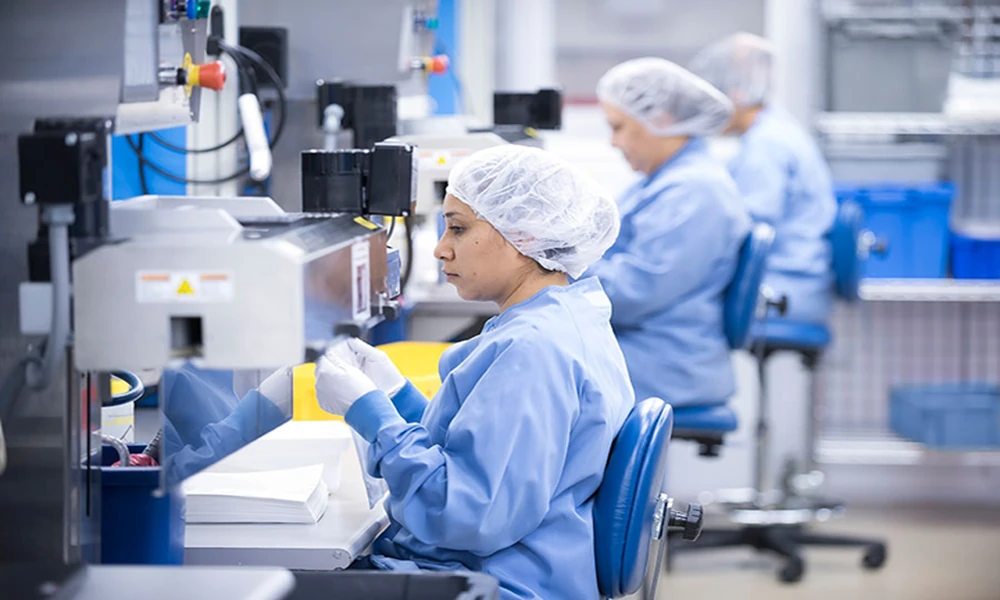
A medical device company in its fifth year of operation faces a problem that its founders did not fully anticipate when they were filing patents and running bench tests. The device works. Clinical data supports it. Regulatory clearance is in hand. The problem is the factory. Every dollar spent on equipment maintenance, process revalidation, cleanroom certification, and quality system audits is a dollar not spent on the sales team, the next product, or the clinical study that will open a new market indication. The manufacturing operation that was a point of pride in year two has become, in year five, an anchor on the company’s growth rate.
This is not a failure of planning. It is the natural consequence of what a medical contract manufacturer exists to solve. Manufacturing medical devices to the quality standard regulators require is a specialised business. Running it well demands sustained investment in people, equipment, quality systems, and regulatory knowledge that most medical device companies would rather deploy elsewhere.
AMT is a medical contract manufacturer in Singapore serving device OEMs at every stage of commercial development, from first-in-human clinical supply through to full-scale production for established market programmes.
Quality Is Not a Department, It Is the Production System
The phrase “quality driven” in medical device contract manufacturing is sometimes used loosely, as a signal of intent rather than a description of how the operation actually works. What quality-driven production looks like in practice is a manufacturing system where quality is built into every process step rather than inspected into the finished product at the end.
This distinction matters because inspection at the end of a process can only sort conforming parts from non-conforming ones. It cannot improve the yield of the process, and it cannot detect failure modes that are not captured by the inspection criteria. A medical contract manufacturer whose quality system is built around end-of-line inspection is managing quality reactively. One whose processes are validated, monitored in real time, and continuously reviewed against performance data is managing quality at the source.
AMT’s quality management system is certified to ISO 13485, the international standard for medical device quality management, with production processes that are validated before supply and monitored against statistical process control data throughout production.
Medical contract manufacturer relationships at AMT begin with a structured technology transfer that establishes the validated process baseline before production parts are supplied to the OEM.
What Technology Transfer Actually Involves
Technology transfer is the process by which the OEM’s knowledge of their product and how to make it moves into the contract manufacturer’s facility and is validated there. It sounds straightforward. In practice it is the phase of the contract manufacturing relationship where most problems originate, because the knowledge required to make a medical device reliably is rarely fully captured in a drawing or a process specification.
The drawing specifies the dimensions. The specification lists the materials. But the knowledge of which dimensions are critical to function and which are generous, which process parameters are tightly linked to product quality and which have wide latitude, and which failure modes are possible and how to detect them early, this knowledge lives in the heads of the people who developed and validated the process on the OEM’s side. Extracting it and documenting it in a form that allows the contract manufacturer to replicate the process without the original development team standing in the room is the real work of technology transfer.
AMT’s technology transfer protocol includes a formal risk assessment of the critical process parameters and critical quality attributes for each product, structured documentation of the transfer deliverables, and a phased validation programme with defined acceptance criteria at each stage before production is released.
Regulatory Coverage Across Multiple Markets
A medical device OEM who places devices on the US market, the European market, and markets in Asia-Pacific is navigating three distinct regulatory frameworks simultaneously. Their medical contract manufacturer must understand all three, because the production records, quality system documentation, and manufacturing process controls required to support regulatory submissions in each market differ in ways that matter during audits and inspections.
FDA’s Quality System Regulation, rewritten as 21 CFR Part 820 with increased alignment to ISO 13485 in recent years, governs US market manufacturing requirements. EU MDR Annex I sets out the general safety and performance requirements that European devices must meet, with the quality system requirements for manufacturers set out in Annex IX. Each framework has its own audit approach, its own record-keeping requirements, and its own expectations of how a manufacturer’s quality system is structured.
Scalability Without Quality Compromise
Volume growth in a successful medical device programme creates a specific challenge for the manufacturing operation: how to increase output without introducing the process variability that tends to emerge when a validated process is pushed beyond the conditions under which it was validated.
Scale-up in a quality-driven medical contract manufacturing operation is managed as a formal change control event. The increased volume is characteristic as a change to the validated process, and the potential impact on product quality is assessed before production at the higher volume begins. Where the assessment identifies risks, additional validation work closes them before the change is implemented. Where the assessment confirms that the process capability is maintained at the higher volume, the change is documented and the validation status is updated.
This structured approach to scale-up produces a higher production volume that is genuinely supported by validated process evidence, not simply an increase in output that the quality system has not caught up with.
Long Term Partnership Economics
The economics of a medical contract manufacturing relationship improve over time as both parties invest in the shared understanding of the product and process. The OEM’s cost of managing the contract manufacturer relationship falls as confidence in the supplier’s quality system matures. The contract manufacturer’s process efficiency improves as accumulated production experience identifies optimisation opportunities within the validated process window.
These dynamics make the choice of medical contract manufacturer a long-term decision with compounding consequences in both directions. A relationship with a manufacturer whose quality system is genuinely capable and whose operational discipline is consistent produces a widening advantage over time. A relationship with one whose quality is marginal produces widening risk.
For medical device companies seeking a medical contract manufacturer whose quality-driven production system, ISO 13485 certification, multi-market regulatory capability, and structured technology transfer process provide the manufacturing foundation for reliable device production, AMT offers the medical device contract manufacturing partnership that Singapore’s medical device industry depends on for consistent, scalable, quality-driven production.
